
Just when you think nothing can surprise you anymore, Vladimir Palancica appears. After writing hundreds of articles about members of our diaspora, he makes you rethink every benchmark. Raised in a family of teachers in Chișinău, he sold friends in the courtyard the toys and sweets his father brought back from business trips. He went on to open two kiosks near four educational institutions, then left for Asia owing money to relatives and friends, with barely enough cash to get by, let alone buy a ticket home. He began in Thailand, handing out brochures to Russian tourists outside hotels, then moved to Cambodia in 2013. Today, he says, he employs approximately 5,000 people. He heads Lotus Group, develops the Time Square residential complexes in Phnom Penh, and was appointed President of BRICS House Cambodia in 2026. He says he does business ‘for the sheer pleasure of it’. One ambition remains: a journey into space, which he has already paid for. He tells the rest of his story himself in a monologue that, once again, I simply couldn’t bring myself to cut short.
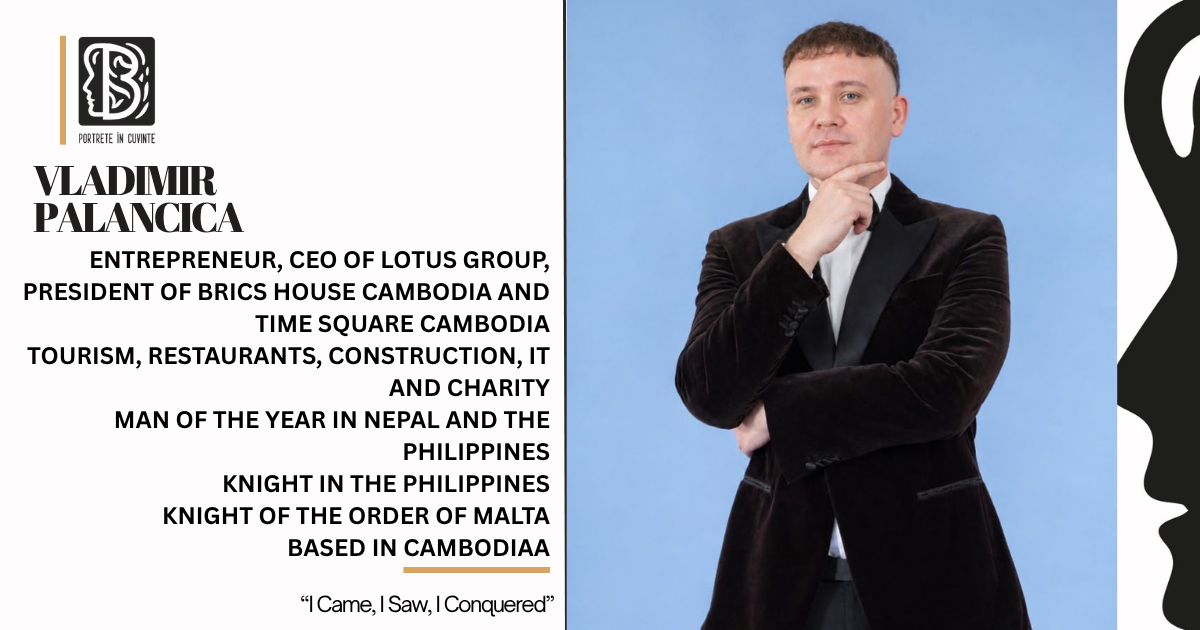
Disciplined, ambitious and determined to win
I was born in Chișinău into an intellectual family: my parents and grandparents were teachers. My father served as deputy head, then head, of a college in the capital for 46 years, while my mother taught Romanian. Growing up with two educators meant discipline above all. My father had thousands of students, and so did my mother; their own child was certainly no exception. ‘Study, study, study!’ was what I heard almost every day throughout my childhood. I had to grow up disciplined, read plenty of books and regularly hand over my exercise books and school diary for inspection. If I was told to do something, I did it, even when I did not always agree.
Because my father was deputy head, he often travelled to neighbouring countries and brought back toys and sweets that weren’t available in our shops at the time. What did I do? I sold them to my friends in the courtyard and made pocket money. My parents, unlike me, had never taken part in the kind of informal trading people then called *bișniță*.
At their encouragement, I spent eight years competing in ballroom dancing at Codreanca and became a seven-time champion. I would have preferred a sport I considered more masculine, such as freestyle wrestling, judo or boxing, but I was an obedient child and did what they wished. I often competed against 200 other couples and consistently placed in the top ranks. Through several training sessions a day, injuries, and discipline, I developed a winner’s mentality and learned not to fear the stage or competition.
I also played chess, went swimming, and took extra English lessons. English was actually the first part of my extracurricular education: I started learning it at about six, when it was neither fashionable nor compulsory.

In Bucharest, I noticed that students ate differently from students back home, with a wider variety of foods than was typical in the post-Soviet environment.
After graduating from Spiru Haret Lyceum, I studied at the College of Informatics and Law before leaving for Romania. There I spent two years studying political science and modern languages at the University of Bucharest. In Bucharest, I noticed students had a wider range of food options than back home, thanks to a variety new to the post-Soviet world. Wanting to start my own business, I returned to Chișinău after two years and, with my parents’ help, registered a sole proprietorship under the name ‘Vladimir Palancica Individual Enterprise’.
I opened two kiosks in the Botanica district of the capital, near four educational institutions. We sold soft drinks, hot dogs, hamburgers, and much more, giving students alternatives to meals from the canteen.
I earned my higher-education degree back home at the Faculty of International Relations, Political and Administrative Sciences (FRIȘPA). Once again, my parents chose the faculty, not me: they dreamed of seeing me become a diplomat. I graduated and, years later, became one, as an ambassador of the Order of the Knights of Malta.
I was tired of endless weddings, christenings and birthdays – and, above all, of owing money to family and friends
After graduating, I threw myself into business. As an inexperienced young man, I made plenty of mistakes. Back then, entrepreneurs like me received no support from the state or banks, not even guidance from more experienced businesspeople.
In a relatively short time, I got married, became a father, divorced, and went into debt while trying to grow my business. I remember it was 2012, and I was tired of the seemingly endless weddings, christenings, and birthdays, but most of all, I was tired of owing money to relatives and friends. The debts suffocated me, leaving me torn between shame and responsibility.
So I left the business to my former wife and set out into the wider world. I headed to Thailand. I thought: if all Moldovans are migrating to Europe, and many are still in the Russian Federation, why shouldn’t I go the other way?
We started as two people and, in just eight months, grew to nearly 50 staff and 12 offices
I went to Phuket, Thailand, where I knew a few people but knew very little about the country. I did a little reading before boarding the plane, and that was it. I left home with $5,000. During my first week, I treated myself to restaurants and nightclubs, spending about $3,000. Then I realised I had roughly $2,000 left, not even enough for a return ticket.
I had to get down to work. Since I spoke fluent Russian and there were many Russian tourists, I decided to try my luck in tourism. I partnered with a Thai national because Thai law requires Thai nationals to own the majority of a company’s capital in certain sectors. We launched a tourism business called Hot Vacations, with my partner holding 51% and me holding 49%.
With the money I had left, I rented an office and paid three months’ rent upfront. I bought furniture, printed brochures, then stood outside hotels handing them to tourists and inviting them to join excursions the next day, to islands, jungles, temples, or wherever else they wanted to explore.
We started with just two people and, in eight months, grew to nearly 50 staff and 12 offices. I recruited young people from Ukraine, Russia, and Belarus, including about ten who came from home at my invitation. We grew so quickly that within eight months, we had become Thailand’s largest tourism company serving Russian-speaking visitors. Within six months, the business was generating enough money for me to pay off my debts back home.

We focused on travellers who had already visited dozens of countries and were seeking places they hadn’t yet discovered. Cambodia was one of them.
Even after that success, I still wanted to move to Cambodia eight months later. The country had simply captivated me. It all started with the idea of bringing tourists from Thailand there. I tried the journey myself, first by plane, then by coach, and it was love at first sight.
I first arrived in a small town with stunning beaches that were almost untouched by tourism. Seeing its enormous potential, I returned to Thailand and told the team I wanted to move there. Some chose to stay, so I sold the business to them.
I moved to Sihanoukville and launched a tourism company called Lotus Tours. When I spoke with a lawyer, I was surprised to learn that foreigners could establish a business in Cambodia without a local partner.
Around ten people from my previous team came with me, including about six Moldovans. I then brought over more relatives and friends from home. With a team of around 15, we launched the new venture: we built another website, obtained a tourism license, opened an office, and began looking for tourists.
We quickly realised that this time, we didn’t want to cater to mass tourism. Instead, we focused on travellers who had already visited dozens of countries and were ready to open a map and look for somewhere new. Cambodia was one of those places.
We began publishing as much information about Cambodia as possible online, in both English and Russian. As the internet rapidly developed, we gradually began hearing from tourists and travel companies arranging exotic trips for extremely wealthy clients.
The niche we’d found was extraordinary. Agencies had customers willing to pay well for unusual experiences, but no one on the ground in Cambodia to work with. We were there and could arrange everything for them, especially trips to Angkor Wat.
The results came quickly. Just three weeks after opening the company, we welcomed our first very wealthy tourists. This was no longer mass tourism; it was luxury travel. In some cases, a single client was worth as much as a hundred ordinary tourists.
Over the years, our clients have included wealthy and exceptionally wealthy people: actors, entrepreneurs, leaders, politicians, internationally renowned celebrities and even people from circles I cannot discuss publicly. They came from across Europe, the United States, Russia and China. Professional ethics and confidentiality prevent me from naming them, but I remain friends with many of them to this day.

Before me, no one from Moldova or, indeed, from more developed countries had come here and tried to live in such conditions
Of course, there were many obstacles. In Cambodia at the time, for example, electricity was available just three times a day, for an hour each time. With temperatures above 40°C, the nights were hard to endure. All of this affected both my ability to work and my personal comfort. Financially, however, I had already become very confident in my abilities. I would tell those who had come with me from Moldova and decided to stay: ‘Ladies and gentlemen, we came, we saw, we conquered.’
Before I arrived, no one from Moldova (or even from more developed countries) had come here and tried to live in these conditions. One had to manage without good roads, many of the services and products you were used to, and sometimes even a way to communicate. I think that frightened many people. For me, it was a challenge that made me want to stay.

Quincom: a five-star hotel complex featuring eight restaurants, souvenir shops, and approximately 670 employees
Every business needs to grow, and I grew alongside mine. As the company expanded, we generated substantial cash flow and signed increasingly larger contracts. Eventually, agencies were chartering entire aircraft filled with tourists specifically for our company.
But growth requires investment. To provide tourists with good conditions, we needed somewhere to accommodate them. So, I asked myself: why not open a hotel? And if they were already coming to us, why not offer them a restaurant where they could eat well?
That’s how we began building a business that covered nearly the entire hospitality sector. We developed Quincom, a five-star hotel complex with eight restaurants and several shops, including souvenir outlets. We also moved into jewellery. Cambodia has a strong tradition of gold and precious stones, so we opened a jewellery shop in the complex. To support these projects, my team grew to around 670 employees.
The company has grown further. Today, we employ around 5,000 people, nearly 4,500 of whom are Cambodian.
Over time, the team became one of my greatest achievements. At one point, we employed 670 people, and around 500 developed professionally alongside me over more than ten years. I know them by name, and I know many of their stories.
Trust, however, took time to earn. Cambodians tend to be reserved and won’t invite you into their homes on your first day. When they made mistakes, I didn’t scold them or dock their pay. Instead, I talked with them, explained what had gone wrong, and encouraged them to learn. In turn, I learned a great deal from them.
They are kind, peaceable people who have endured an extremely difficult history, including decades of civil war, genocide, and many other hardships. Perhaps that is why they value stability and the chance to work and build a future in their own country so highly. During COVID, even though I was losing money, I could not bring myself to make them redundant.
Some started out as drivers, cooks, waiters, sales assistants, or in other roles, and gradually advanced within the company. They were eager to learn, and I was glad to give them the opportunity.
Meanwhile, the company continued to grow. Today, we employ approximately 5,000 people, nearly 4,500 of whom are local. Many have large families, with five or six children, so the jobs we’ve created indirectly support thousands upon thousands of people. I sometimes joke that I have a small army.

The move from tourism into property development was driven primarily by customer demand
As Cambodia developed, more tourists began considering settling there. Roads were built, shopping centres opened, and infrastructure improved, making the country increasingly attractive to those seeking a new home. However, quality housing for foreign nationals remained scarce. Apartments and villas were built to the standards they were used to in their home countries.
That’s how the idea for the construction business began. It has now been operating for 12 years. We entered the market gradually, and step by step, I built what has become one of Cambodia’s largest construction companies: Lotus Group.
The move from tourism into property development was driven mainly by customer demand. People asked if I could help them buy land, build a villa, or open a hotel or restaurant. I did my best to guide them through setting up a company and starting a business in Cambodia. I have never feared competition. In fact, I would say: ‘I like competition. It means progress. It means development. If you create something worthwhile, I will learn from you.’ As these requests grew, I realised there was a real opportunity. I left the coastal city for Phnom Penh and entered the property market.
There I met a young woman from China who was working to build her business. She was struggling to get started, so I decided to help by bringing her around 30 clients who paid in full upfront. She was deeply impressed and invited me to dinner. That was the beginning of another story – one that has lasted 12 years as well. Together, we’ve built a family and a business, and we’re raising a child.
Twelve property developments, some comprising towers of approximately 40 to 50 storeys
The company has been active for more than a decade, and today we have developed 12 property projects, including towers of around 40 to 50 storeys. Some are complete and handed over, while others are at various stages of development. Altogether, we are talking about thousands of apartments in Phnom Penh, already home to tens of thousands of people.
Last year, I launched my first coastal project. Until then, traveling from the capital to the coast had been difficult and time-consuming. Since then, a state-of-the-art motorway has transformed access to the seaside.
The development is just 50 metres from the sea and comprises 1,500 apartments. We sold them all in just five months, before construction had even begun. It is one of the projects I am proudest of, as it says so much about the reputation we have built and the trust people place in our company’s name.
Another development that makes me very happy is the changing buyer profile. When we launched projects under our Times Square Cambodia brand, the apartments sold very quickly. But under what circumstances?
Ten years ago, Cambodians made up less than 23% of apartment buyers. Today, they account for more than 50%. To me, this signals the emergence of a middle class in Cambodia with the means to buy a new home. Our apartments range from about 70 to 250 square metres and average around $1,500 per square metre. The smallest apartment I sold was a 40-square-metre unit with a sea view, which cost $50,000.

Where does the developer behind Time Square live?
Although I develop the Time Square projects, my wife and I lived in a one-bedroom apartment of about 60 square metres for eight years. My home is in the very first building I constructed. After our child was born, however, we needed more space, so we joined two apartments together.
Even so, I have remained a fairly modest person. I don’t feel the need to spend lavishly on unnecessary indulgences. I prefer to invest a significant portion of what I earn in charitable projects and other people.
I examined everything – from how buildings were constructed to how quickly the lift arrived
For an entrepreneur, the challenges go beyond selling and making a profit. Above all, they involve keeping everything under control and delivering on time. People depend on you, so you must pay wages and taxes on time, and the products you sell must be high quality. After all, every customer contributes to the company’s reputation in some way.
I was always learning. My team and I visited other hotels to see how they operated, and we were never ashamed to learn from those who did things better. Before starting our construction projects, for instance, I visited many countries and inspected numerous buildings. I looked at everything: how they were built, how many seconds the lift took to arrive, how high it travelled, how many parking spaces there were, and how the whole space was organised.
I did the same with hotels. I visited some of the world’s most expensive hotels like Hilton, Marriott and Hyatt, and studied every detail. I even paid attention to things guests might not consciously notice: the scent as they enter, the restful colour choices, the background music, and the shampoo and toilet paper in the bathroom. I learned from what I observed and applied it.
A garment factory in Vietnam, an IT business, consultancy services and the presidency of BRICS House Cambodia
At a certain point, I began looking towards other sectors. I established a consultancy company and later a garment factory in Vietnam. During the pandemic, as the world changed, we adapted the factory’s operations and began producing medical masks. In business, as in life, you have to be able to adapt very quickly.
In 2021, I also entered the IT sector. With partners from Israel, China, and the United Arab Emirates, I opened a company in Dubai. It focused on IT services, including projects for the Chinese market. It was unlike anything I had done before, and that was precisely what appealed to me. I have never wanted to be confined to a single industry.
After gaining experience in tourism, construction, and business development, I also began offering consultancy services. At first, I simply helped people because I enjoyed it. Later I realised that the experience I had accumulated over so many years could become a service in its own right. I had already made many of the mistakes newcomers were about to make, and I could help them avoid them.
In 2026, I became more involved in developing economic and tourism relations between Cambodia and Russia, as well as countries in the BRICS sphere. In February, BRICS House Cambodia was inaugurated in Phnom Penh, and I was appointed its president.

What does being a leader mean to me?
To me, a leader is someone who believes deeply in their ideas and can inspire those around them to share that conviction. But it is a long journey, because you don’t build a strong team in a day. Among our 5,000 employees are managers and directors who joined me when they were young. They grew with the company and eventually came to lead departments.
Of course, we’ve made mistakes. How could there not be? My biggest entrepreneurial mistake was not always choosing the right people to work with. I trusted and took on individuals as partners. They lied to me, and I suffered setbacks as a result. Ultimately, though, time showed that they didn’t get richer, and I didn’t get poorer.
Becoming an adviser to Cambodia’s Prime Minister can be easier than becoming a citizen
In Cambodia, becoming an adviser to the Prime Minister can be easier than obtaining citizenship. I met Hun Manet, the current Prime Minister, several years ago, before he held that office. We had several private discussions about Cambodia’s development, its economy, and tourism in particular. He is relatively young, has studied at several renowned universities around the world, and has a vision to make Cambodia more prosperous and a better place for its people to live.
Over time, my experience in tourism, the thousands of jobs I created, my position as one of the country’s major taxpayers and the significant projects I developed here strengthened our relationship. Eventually, he invited me to become his adviser.
Today, I advise on economic matters, especially those related to tourism. I consider this an important responsibility, as it allows me to draw on the experience I’ve gained over the years to help develop Cambodia’s tourism industry.
I received citizenship by decree of the King
In many Asian countries, you can live for decades, marry, have children and build a business without automatically becoming entitled to citizenship.
My circumstances were somewhat different. In recognition of my contributions to the country’s development, the jobs I created, the many local people I employed, and my contribution to Cambodia’s economy, I was granted citizenship by decree signed by Cambodia’s King, Norodom Sihamoni. I also received an honorary title for my contributions to the Cambodian state and its people.

Two airports
My contribution to tourism development has not been limited to the company I built.
I established an association of Cambodian tour operators and organised numerous exhibitions and events abroad to promote the country. I also helped facilitate direct flights to Cambodia from various countries, making it more accessible to tourists.
I also contributed to the construction of two airports, including Techo International Airport, Phnom Penh’s new airport, which opened in 2025. The airport covers approximately 2,600 hectares and is among the world’s largest by area.
Man of the Year and Knight of the Order of Malta
As I began earning more, I became increasingly involved in charitable work and projects benefiting local communities. Over time, this work earned me the title of ‘Man of the Year’ in several countries, including the Philippines, Japan, and Nepal. I was also honoured as a Knight of the Order of Malta and knighted in the Philippines at a ceremony where I wore traditional Moldovan clothing.
For me, however, these distinctions aren’t about titles. Being decorated means I’m noble, not in the aristocratic sense, but because I want to improve the lives of those around me.
In Nepal, for example, I helped build water-supply systems and schools in four communities.‘
You have cancer and probably only a month to live’
The year 2021 was a difficult turning point in my life. When a doctor tells you, ‘You have cancer and probably only a month to live,’ you lose your breath for a few moments. I was around 35 and had oesophageal cancer. My first question was: ‘Why me? What have I done wrong in this world to find myself in this situation at this age?’ In the end, things weren’t as serious as they first seemed. I went to Israel for treatment, and the problem was resolved relatively quickly. Psychologically, though, something stays with you forever. For the first time, I truly understood that life can be short and that there is no guarantee you will have time for everything you set out to do.
From that moment on, many things changed, though not necessarily as people might have expected. I continued my charitable work, but began to think differently about how I spent my time. Things that had once seemed terribly important began to matter less. Instead, I focused more on the people who mattered in my life: seeing my family more often, spending time with loved ones, and making time for myself.

Chess teaches you a particular way of thinking
As I mentioned at the beginning of the article, I was also a chess champion, and chess taught me to think several moves ahead. I’ve approached business the same way. I still have plans for expansion and new projects. In October or November, we’ll launch a major property development with 3,000 apartments, a shopping centre, an international school and a private beach. This is an important project for me, and I believe it will significantly transform Sihanoukville.
Looking back, I regret a few things. I regret not learning more foreign languages, not leaving Moldova earlier and, above all, not spending more time with my grandparents. Otherwise, I regret nothing. Every stage, including the difficult ones, has brought me to where I am today.
I do business because I enjoy it
I do business because I enjoy it. I have often wondered whether it might be time to stop, whether I have done enough and should move on to something else. But each time, something new comes along. I am also involved in diplomacy, representing Cambodia and promoting the country’s image and international tourism. Tomorrow, I leave for Hong Kong to represent the Cambodian government at an international forum. I continue my charitable work and am now considering an agricultural project as well. I was born in Chișinău, but I spent much of my childhood in the countryside with my grandparents, and I think that is where my connection to the land comes from. At the same time, I try to spend as much time as possible with my youngest son.
I have another personal ambition: to visit every country in the world. So far, I have visited 80. I love seeing the world and understanding how people live, build and think. That curiosity has probably helped me enormously in business too.
Once I started paying wages and taxes and saw the business thrive, money stopped being my main motivation. I believe people who go into business purely for the numbers will struggle to achieve truly impressive results. After you pass a few million dollars, you start to see business differently. You no longer measure it solely by money; you begin to value growth, stability, the people who work and grow alongside you, the brand you build, and the legacy you leave behind. You realise that business isn’t just about how much you earn, but also how many others can earn because of it, how many families can enjoy a stable income, and how many people can learn a trade and develop alongside you.
I also have a few personal wishes unrelated to business. One is to go into space. I am enrolled in a spaceflight programme and have already paid for the experience, though my turn to fly hasn’t come yet. So the story continues…
Article translated by Sanda Beniamines


